- October 19, 2026
- by admin
When a Survey Link Doesn’t Work as Expected: A Market Research Case Study
How language checks and careful quality control can help prevent confusion in multilingual online surveys.
A survey link might look like a small part of a market research project, but it plays an important role in the respondent experience.
Researchers can spend weeks preparing questions, selecting target audiences, and coordinating fieldwork. Yet if respondents receive unclear instructions, encounter language inconsistencies, or struggle to understand a question after opening the link, the quality of the collected data may suffer.
These issues can be particularly challenging when a survey is launched across several countries and languages.
Let’s look at a practical example of how a seemingly minor issue with a multilingual survey can create unnecessary complications.
The Case: A Multilingual Survey Ready for Launch
Imagine a market research agency preparing an online consumer survey for respondents in the United Kingdom, Saudi Arabia, and Mexico.
The English questionnaire has been approved, and translated versions are ready. The research team distributes the survey links to the relevant respondent groups and prepares to begin collecting responses.
During the initial checks, however, the team notices a few inconsistencies.
Some respondents receive instructions that don’t read naturally in their language. A question in one localized version appears to communicate a slightly different meaning from the English original. In another version, the response options use wording that could confuse respondents.
The survey link itself opens correctly, but that doesn’t necessarily mean the survey is ready.
The team needs to check more than whether the URL works. It needs to confirm that respondents can access the correct language version and understand the questions as intended.
Where Things Can Go Wrong
1. The link opens, but the respondent experience is unclear
A working survey link is only the first step.
Respondents also need clear instructions explaining what the survey is about, how to answer the questions, and whether they need to complete any specific steps.
If those instructions are translated too literally, respondents may hesitate or interpret the task differently from what the researcher intended.
For example, an instruction such as “Select all that apply” must clearly communicate that more than one answer may be selected. If the localized wording suggests that respondents should choose only one answer, the resulting responses may not reflect the intended question format.
2. Different language versions ask slightly different questions
When questionnaires are translated separately, inconsistencies can appear in question wording, terminology, and response options.
Consider a question asking respondents how satisfied they are with a service. If the translated versions use different levels of intensity across the response scale, respondents in different markets may interpret the options differently.
The questions might look similar on screen while producing less comparable results.
This is why checking the translated text against the approved source questionnaire is important before launching the survey.
3. Survey changes are not reflected in every version
Imagine the research team updates a question after reviewing the first draft. The English version is corrected, but the change is not carried over to one of the localized questionnaires.
Now, respondents in different markets may be answering different versions of the same question.
This can happen when multiple language files, survey links, and revisions are managed separately without a clear version-control process.
A final comparison of the approved questionnaire versions can help identify these inconsistencies before they affect data collection.
How to Check a Multilingual Survey Before Launch
A structured pre-launch review can help research teams catch issues while they are still easy to correct.
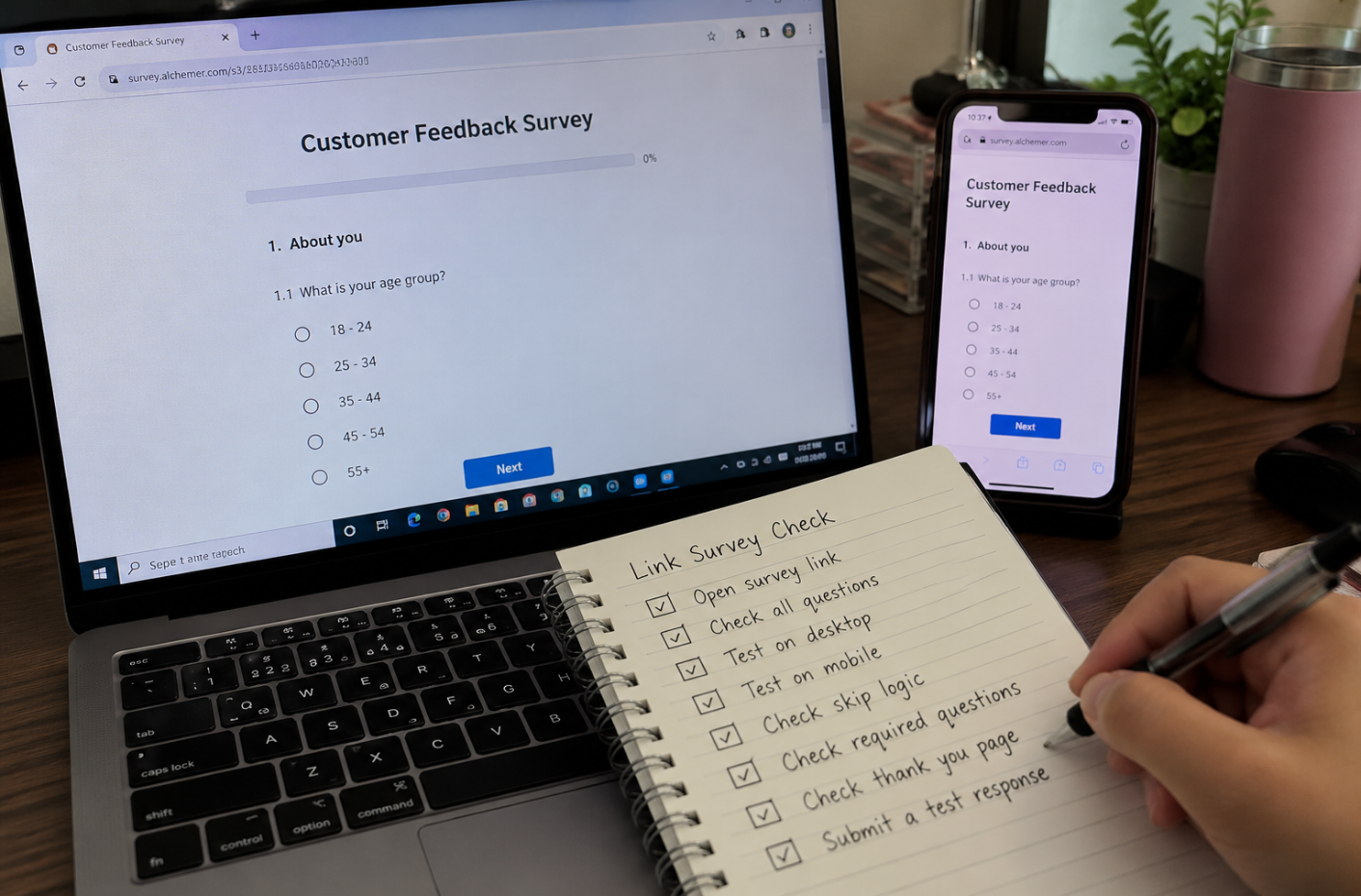
Step 1: Test every survey link
Open each link and confirm that it directs respondents to the intended survey and language version. Check that the survey loads properly and that the relevant sections, instructions, and response options are visible.
If the survey uses routing, branching, or eligibility questions, test those paths as well.
Step 2: Review the translated questions in context
Don’t review translated questions as isolated sentences in a Word document alone.
Check how the text appears in the actual survey interface. A translation that looks fine in a document may become awkward when displayed alongside answer choices, instructions, or buttons.
Pay particular attention to longer questions, mobile screens, and languages that use different writing systems or text direction.
Step 3: Compare questions and response options across languages
Create a comparison checklist using the approved source questionnaire.
Check that each language version preserves the intended meaning of the questions, the number and order of answer options, the response scales, and any instructions that affect how respondents answer.
For multilingual research, consistency matters just as much as readability.
Step 4: Check revisions before distributing the links
If a question changes, identify which language versions are affected and confirm that the corrections have been reviewed.
Use clear file names, version numbers, and approval records so the research team knows which questionnaire is ready for fieldwork.
Step 5: Complete a final respondent-perspective review
Before launch, go through the survey as if you were a respondent encountering it for the first time.
Are the instructions clear? Do the questions make sense? Are the answer options easy to distinguish? Does the survey behave as expected from beginning to end?
This final check can reveal problems that are easy to overlook when reviewing individual translation files.
4. A Searchable Transcript Is Only Useful If You Can Trust It
Transcription makes interview data easier to review, search, and organise. But a transcript is not automatically accurate simply because it is neatly formatted.
Background noise, overlapping speakers, unfamiliar names, technical vocabulary, and poor audio quality can all affect the final text. Automated transcription tools may also misinterpret a word while producing a sentence that looks perfectly reasonable.
In market research, a small transcription error can change the meaning of a statement.
Imagine a participant discussing a feature they rarely use. If an important word is misheard, the transcript could suggest the opposite of what they intended to say.
Researchers who rely on the written version without checking questionable passages may carry that error into their coding, quotations, and final report.
A practical approach: Establish a review process that prioritises the parts of a transcript most likely to affect your conclusions.
Check unclear passages against the recording, verify names and technical terms, distinguish between speakers correctly, and confirm quotations before using them in reports or presentations.
You don’t necessarily need to treat every second of every recording as equally difficult. However, any section that affects a key finding deserves careful attention.
What About Survey Responses After Collection?
Quality checks shouldn’t necessarily stop when the survey closes.
In some projects, open-ended survey responses need to be translated for analysis, while recorded follow-up interviews may require transcription and translation.
These are separate tasks from checking the survey link itself, but they are part of the wider multilingual research workflow.
For example, a respondent may provide a detailed answer in Spanish that the research team needs to review in English. An accurate translation should preserve the respondent’s intended meaning, including relevant nuance, rather than reducing the answer to a simplified summary.
Where interviews are recorded, accurate transcription can also help researchers review what participants actually said before the material is translated or analyzed.
The appropriate workflow depends on the research design, the type of data collected, and the client’s requirements.
Four Practical Lessons for Research Teams
1. Don’t treat a working link as proof that a survey is ready.
Test the link, the language selection, the questionnaire content, and the respondent experience.
2. Keep one approved source of truth.
Maintain a controlled master questionnaire and ensure that revisions are reflected in every required language version.
3. Involve linguists before the final deadline.
Allow time for questions, clarification, and corrections rather than waiting until respondents are ready to begin.
4. Plan for the complete research process.
Consider translation, transcription, and linguistic review during project planning, especially when responses from several markets will eventually be compared.
Better Survey Preparation Starts Before Fieldwork
A survey link is the point where all the preparation becomes a real respondent experience.
When the link, instructions, and localized questionnaire work together, respondents have a clearer path through the survey, and researchers can focus on collecting the information they need.
No checklist can guarantee perfect data, but a careful multilingual review can help reduce avoidable language and consistency issues before fieldwork begins.
At Transcribe & Translate, we support multilingual research workflows through translation, transcription, proofreading, and related language services. Preparing research materials for different markets requires attention not only to the words on the page but also to how respondents and researchers will use them.
If you’re preparing a multilingual survey, questionnaire, or interview project, consider making linguistic quality checks part of your preparation from the start.
Planning a multilingual market research project?
Let’s discuss how Transcribe & Translate can support your research materials and language requirements.
